If you're doing Windows network development—especially firewalls, VPNs, network monitoring, or similar tools—WFP (Windows Filtering Platform) is unavoidable. However, terms like drivers, kernel, and Callouts can be intimidating.
This article won't dive into complex API details. Instead, it aims to explain, in the simplest terms possible, what WFP is, what it can do, and how it works internally.
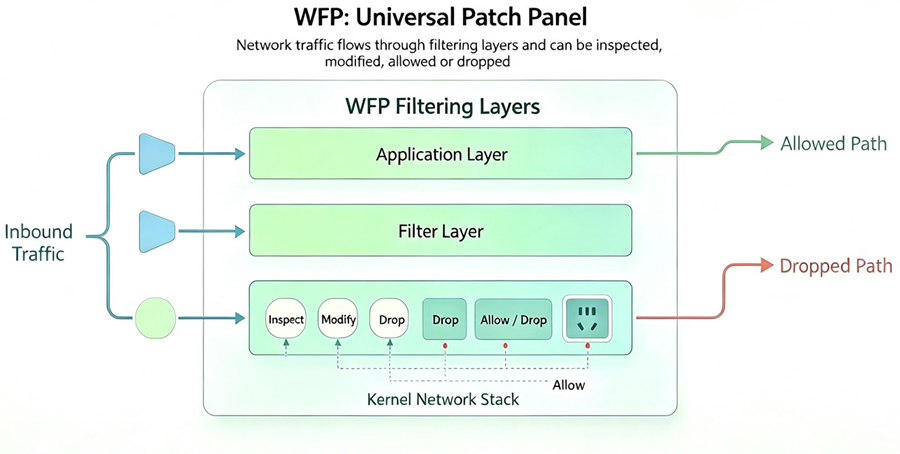
In one sentence: WFP is a "universal power strip" embedded in the Windows kernel network stack.
It provides "sockets" (filtering layers) at all key points where network data passes through. You can plug your own processing logic ("plugs") into these sockets to intercept, inspect, modify, and allow/block network traffic.
The built-in Windows Firewall itself is Microsoft's own "plug" inserted into these sockets. Antivirus software, parental controls, and traffic monitoring tools all leverage this same infrastructure.